


Learning Spanish goes far beyond memorising vocabulary lists, grammar rules, and sentence structures, just as it does with any other language. Acquiring a new language means embracing a new way of expressing yourself and connecting with the world around you.
There are many ways to learn, but one of the most important factors is knowing how to organise new words and structures in your mind so you can express them naturally and communicate effectively.
That’s why developing not only linguistic knowledge but also communicative intuition is essential: understanding when and how to express yourself in Spanish, recognising different contexts, and adapting smoothly to each situation.
Whether you want to keep up a conversation with a friend, share something that happened to you recently, stand out in a job interview, or deliver a presentation to your entire team, you need more than grammar to support you.
As a selector and coach for international speakers, including TEDx Basel and other organisations, I discovered that, regardless of the language, any speech, whether formal or informal, can sound natural and confident by following a simple yet effective method. For me, this is the final step in achieving true fluency in a foreign language.
Over the years, I’ve realised how much I enjoy guiding others through this process; helping them develop fluency, confidence, and natural communication in Spanish. Anyone can learn the basics to navigate a foreign language, but not everyone reaches full expressive fluency. And that is what makes the difference between incomplete learning and true mastery.
In 2022, one of the speakers I selected and trained for TEDx Basel in Switzerland was included in the official global TED Talks repertoire thanks to the power of his message and the clarity of his delivery. It was a proud moment and a confirmation that communication is so much more than building sentences and applying grammar rules, it’s how you say things, when you say them, and the meaning you convey.
So let’s get straight to it! these are my essential recommendations to help you speak Spanish more fluently and naturally:
– Think in Spanish because that is what makes you fluent (and I know exactly how to help you get there)
– Use real conversational connectors to sound more native and fluid.
– Use Spanish sentence starters.
– Adapt your Spanish to each context: social, professional, or formal.
– Learn idioms and expressions.
– Develop storytelling abilities to express experiences and ideas effectively.
– Adapt your voice and body language to enhance your message and presence…and body language is huge in Spanish culture. Seriously, get those hands moving!
– Embrace mistakes because they accelerate fluency and communication skills.
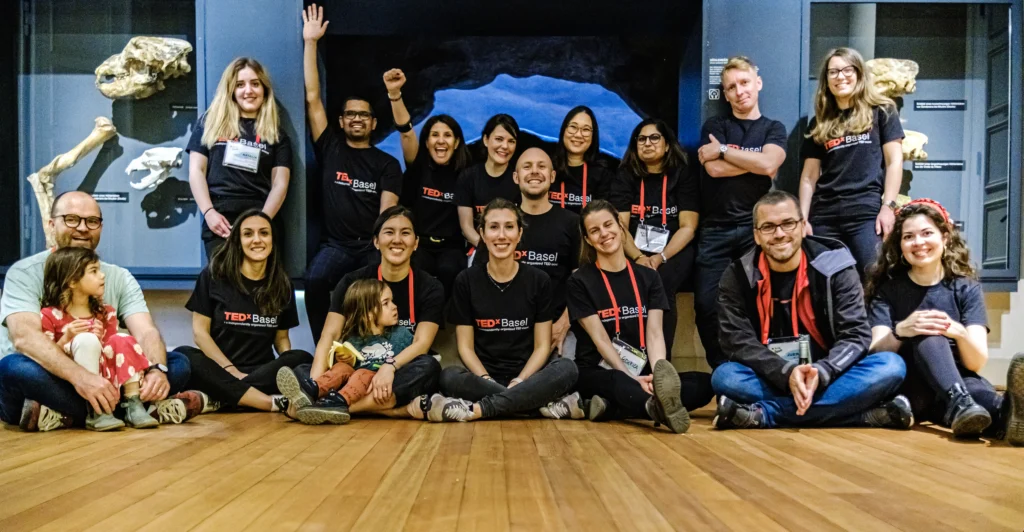
TEDx Basel Team in Switzerland. Can you spot me? 😉